Domain ARiThmetic (DART) adapts VLA models under environmental shifts in a one-shot manner through subspace-aligned weight arithmetic.
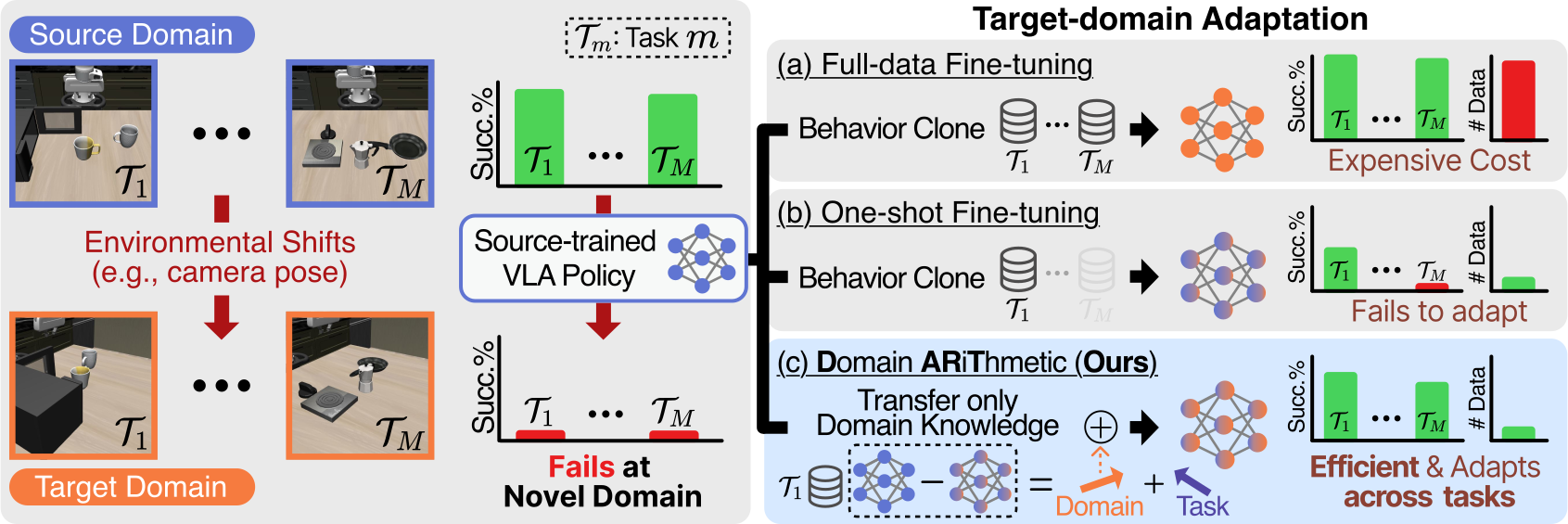
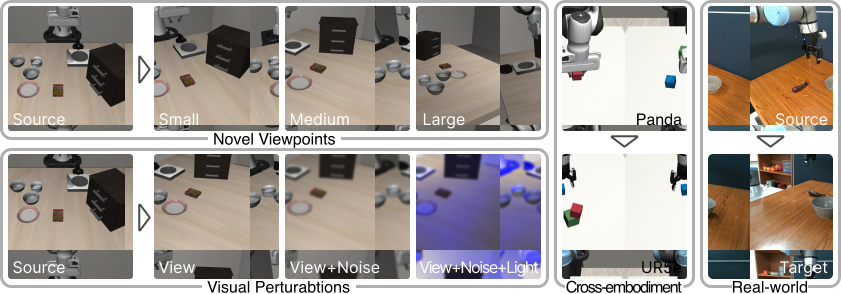
Vision-Language-Action (VLA) models often fail to perform the same learned tasks under environmental shifts, such as changes in camera pose and shifts to a different but similar robot (e.g., from Panda to UR5e). Adapting these models to the shifted environment (i.e., target domain) often requires training on multiple demonstrations for each task, which are costly to collect.
To reduce the burden of data curation and training, we propose a simple analogy-based method that adapts VLA models under environmental shifts through weight vector arithmetic with domain-specific information addition, named Domain ARiThmetic (DART). Unlike prior approaches, DART requires collecting only a single demonstration, enabling efficient adaptation. To accurately isolate domain-specific information for addition, DART performs subspace alignment between singular components in weight vectors to filter out noisy components.
In both simulated and real-world experiments, DART outperforms existing VLA adaptation methods in one-shot scenarios across diverse visual and embodiment shifts.
Why is adapting VLA policies to a new environment still expensive?
Vision-Language-Action (VLA) models can solve many learned tasks in their source environment, but camera-pose changes, sensor noise, or embodiment shifts can degrade performance.
Adapting every task requires costly target-domain demonstrations.
It improves the demo task, but fails to generalize across tasks.
DART extracts domain knowledge from one demo and applies it across tasks.
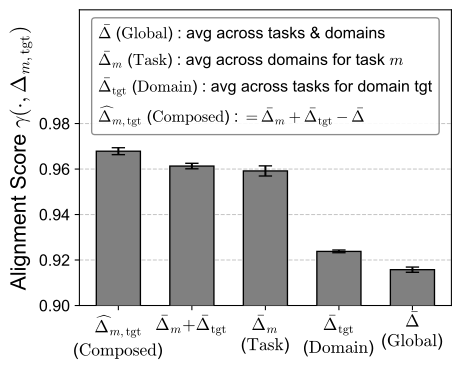
One-shot updates mainly capture task behavior, but also contain reusable domain directions.
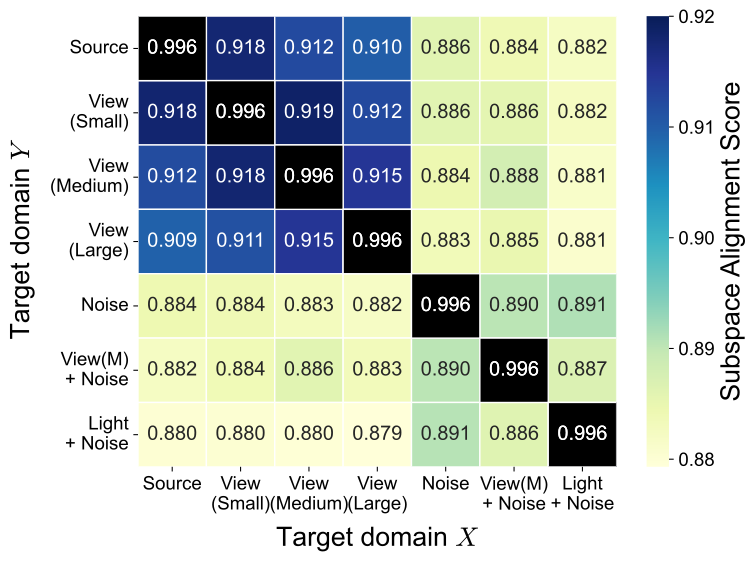
Update vectors from the same task align strongly across domains, but they also contain consistent domain-shared components that can be separated and reused.
Viewpoint shifts, camera noise, lighting changes, and their combinations induce structured directions rather than arbitrary fine-tuning noise.
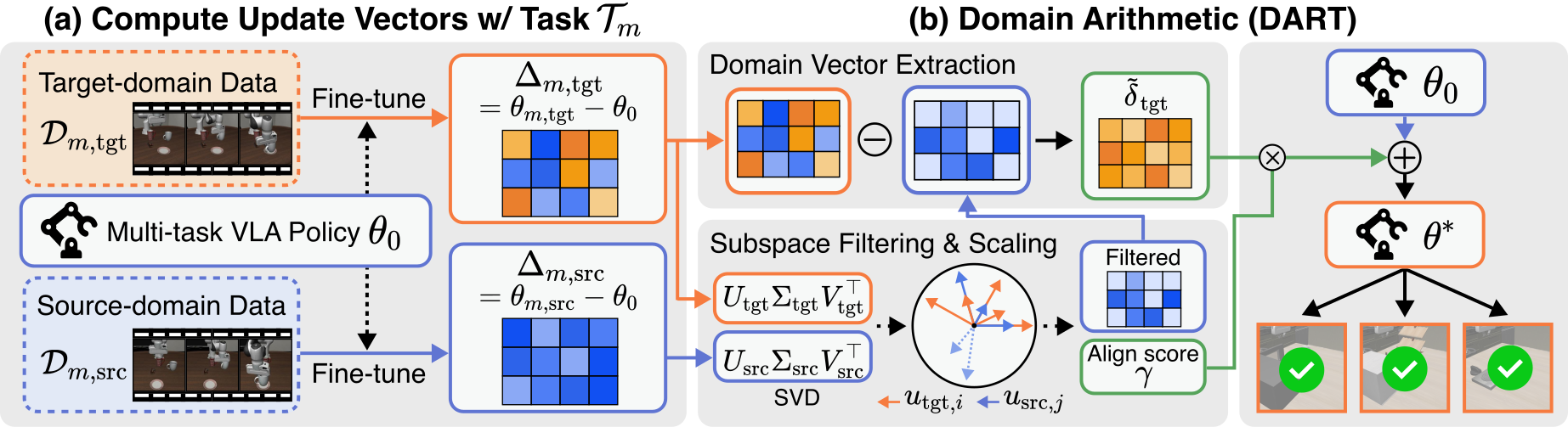
DART extracts a target-domain vector by subtracting shared task directions, then injects it into the base policy.
Fine-tune the base VLA model on one source-domain and one target-domain demonstration of the same task.
Compute source and target update vectors from the base model, then subtract the source update to cancel task-specific directions.
Use subspace filtering to subtract only aligned source components and suppress source-domain artifacts.
Scale the refined domain vector by alignment quality and add it to the base model for target-domain adaptation.
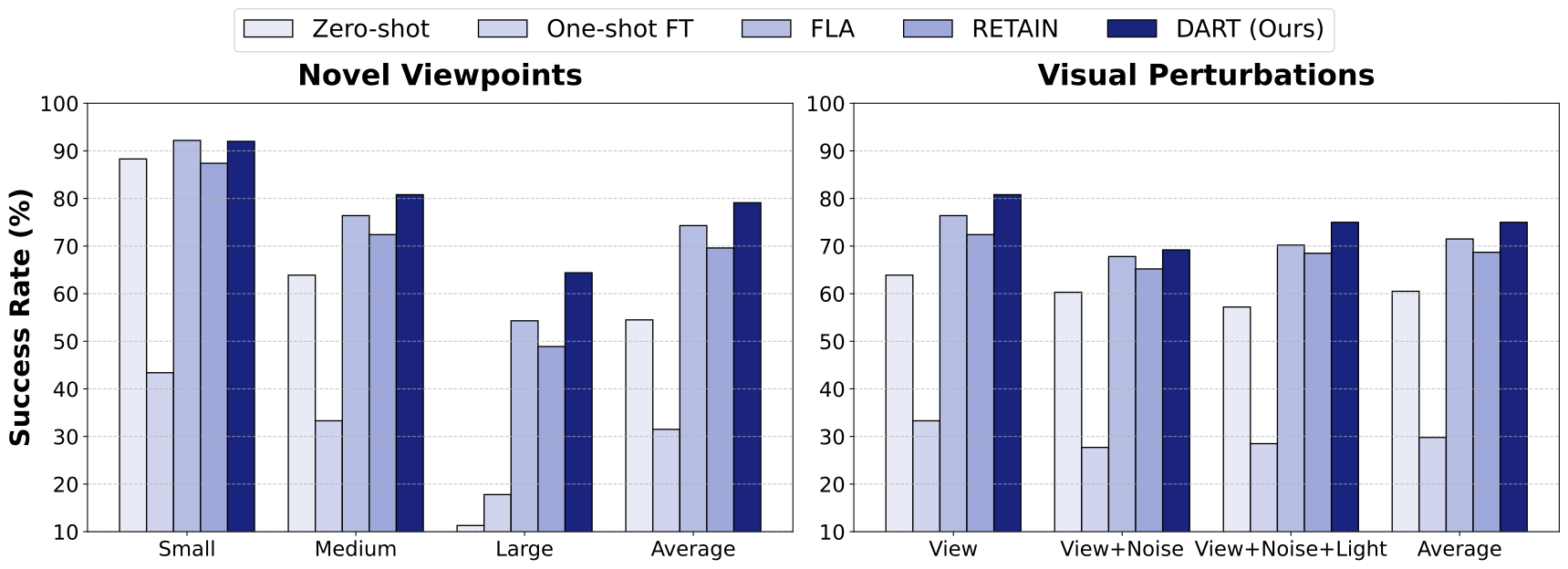
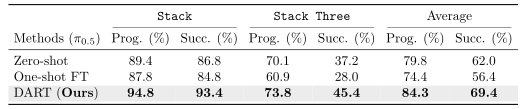
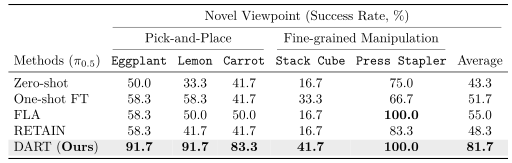
DART consistently improves one-shot adaptation in simulation and real-world robot experiments.
On LIBERO with π0.5, DART reaches 79.1% average success across Small, Medium, and Large viewpoint shifts, outperforming FLA and RETAIN.
On MimicGen, DART transfers a Panda-trained policy to UR5e and improves average success to 69.4% across Stack and Stack Three.
Using one Stack Cube target demonstration, DART achieves 81.7% average success across five UR10e real-world tasks.
@inproceedings{kang2026dart,
author = {Kang, Taewook and Kim, Taeheon and Shin, Donghyun and Choi, Jonghyun},
title = {Domain Arithmetic: One-Shot VLA Adaptation under Environmental Shifts},
booktitle = {ECCV},
year = {2026},
}